
Under REACH, an article may not contain a Candidate List substance above 0.1 % by weight. The Candidate List currently holds 253 entries (last updated 4 February 2026), and it changes twice a year. "REACH compliant" is therefore a statement about a list version, not a permanent property of a material — which is why the document set, not the certificate, is what survives an audit.
Every year we see the same sequence: a European buyer approves a supplier on a declaration issued two years earlier, the Candidate List is updated, and the material is suddenly non-compliant without a single change to the formula.Here is the document set that closes that gap.
Microfiber leather is a composite: non-woven microfiber base, PU impregnation, top coat, sometimes a flame-retardant package and a colour layer. Each layer is a place where a restricted substance can enter.
A material can pass every physical test and still fail on document review at one of these layers.
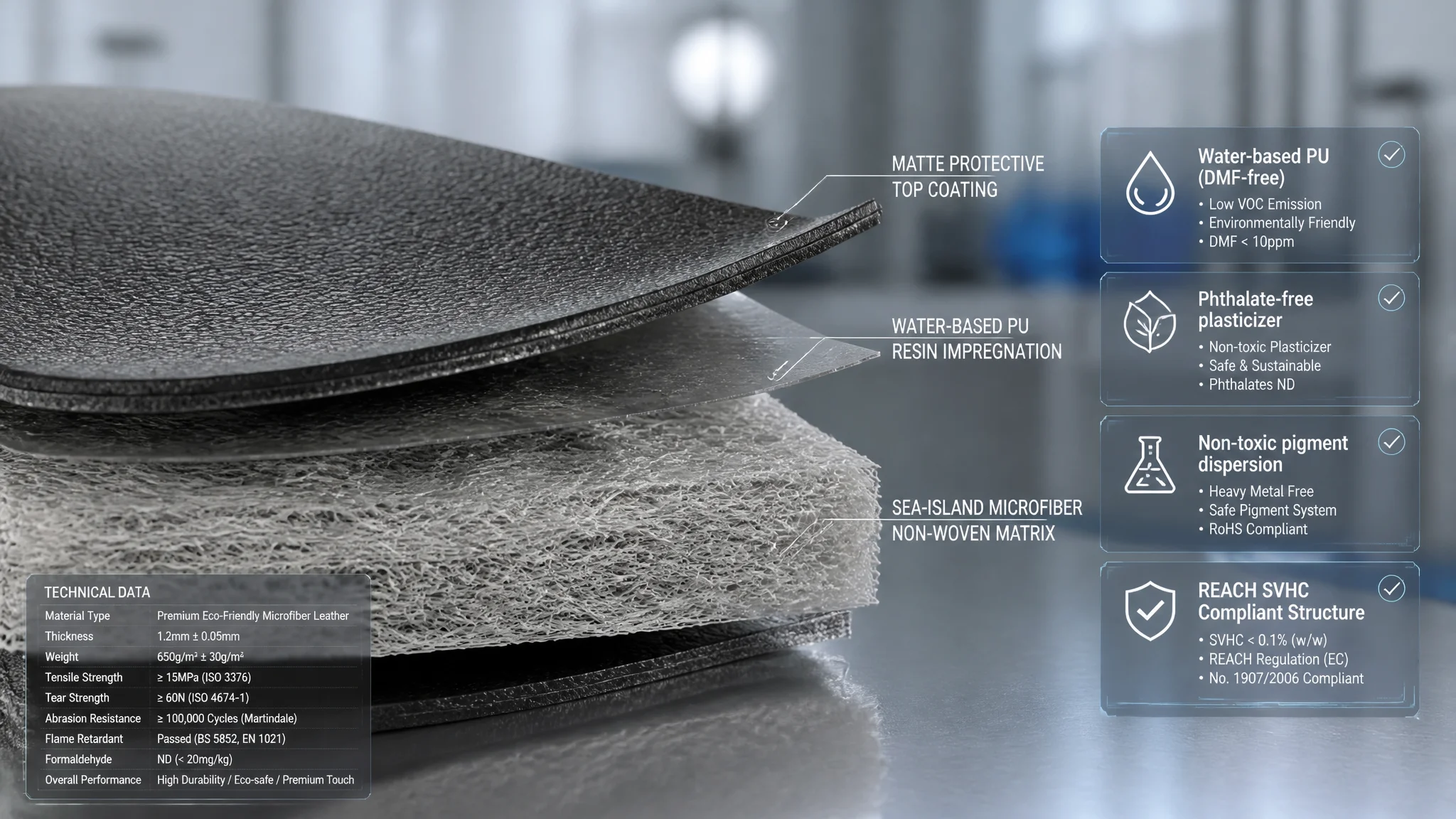
① Full material decomposition (layer by layer). Not "PU + microfiber". Each layer, each additive, each supplier of each additive. If a flame-retardant package is sub-contracted, its composition must be declared too. Without this, no lab can design the right test panel.
② SVHC screening report from an accredited laboratory. Method matters: GC-MS and LC-MS for organics, ICP-OES/ICP-MS for metals, ion chromatography for the inorganic salts. The report must list detection limits — a result of "not detected" with no stated limit is not evidence of anything.
③ The list version the report was tested against. A report tested against the 2024 list does not cover the 253 entries current since 4 February 2026. The correct wording is explicit: "screened against the Candidate List as updated on 4 February 2026 (253 entries)". This single sentence is the difference between a document and a defence.
④ A signed Declaration of Conformity referencing that same version. Signed, dated, on company letterhead, naming the product code and the batch range it covers. A generic PDF titled "REACH Certificate" is not a DoC.
⑤ Annex XVII compliance statement. Separate from SVHC. Annex XVII restricts substances outright — azo colourants, formaldehyde in textiles, certain phthalates, cadmium. A material can be SVHC-clean and still breach an Annex XVII limit.
⑥ SCIP notification reference (if you sell into the EU). Where an article contains a Candidate List substance above 0.1 % w/w, the EU supplier must submit it to ECHA's SCIP database. Ask for the SCIP number; if the supplier is outside the EU, your own notification obligation depends on your role in the chain.
For automotive interiors, add three more: VDA 270 (odour), VDA 278 (VOC/VOCct), and VDA 275 (formaldehyde release). These are not REACH obligations, but they are the tests that decide whether an OEM accepts the part.
Red flag 1 — "REACH compliant" with no list version. The phrase alone is meaningless. Ask which version, on what date, for which batch.
Red flag 2 — XRF screening presented as a full test. XRF is a fast screen for heavy metals only. It says nothing about phthalates, azo dyes or PFAS. A report that is 90 % XRF and 10 % conclusion has not tested the material.
Red flag 3 — no detection limits. "ND" is only meaningful next to a limit of detection. A limit of 1,000 ppm cannot support a 0.1 % claim in any useful way.
Red flag 4 — a declaration older than the latest Candidate List update. Since the list changes twice a year (typically January/February and June), a declaration over six months old is already stale by design.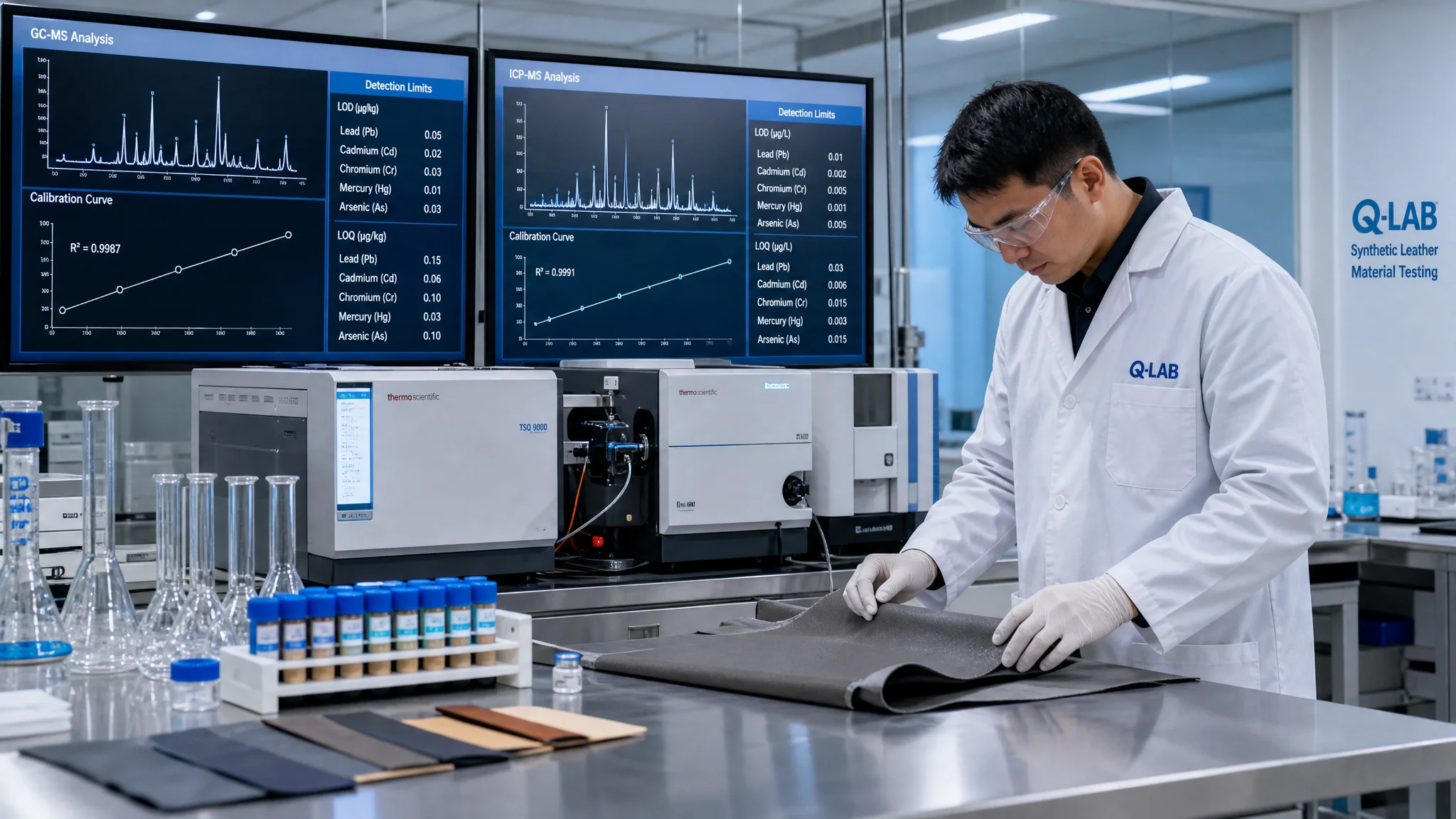
These two get conflated constantly.
A serious supplier states both, separately, with the test evidence for each. If a supplier answers "we are eco-friendly" to a REACH question, you have learned nothing.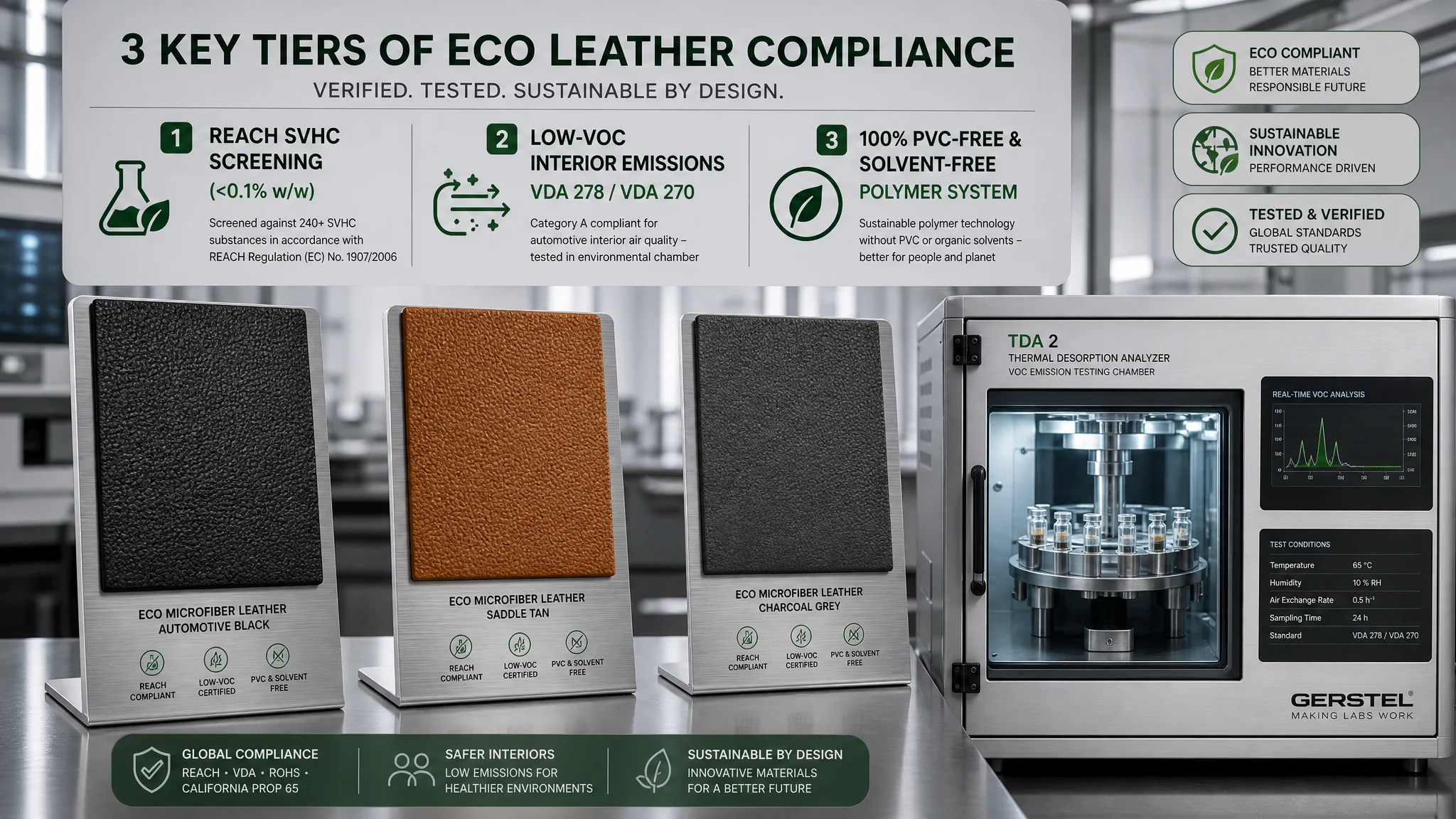
For interior applications, compliance has moved from "no restricted substances" to "no emissions". Two different questions:
A material can be fully SVHC-clean and still fail an interior odour panel — usually because of residual solvent in the PU or an amine-based catalyst. Water-based PU systems exist precisely to close that gap, at a higher unit cost.
If a supplier can return all eight within a week, you are dealing with a manufacturer. If they return two and a logo, you are dealing with a trader.
Discovery is usually late: the goods are made, the container is booked, and the lab report says one substance is over the line. There are three routes, in order of cost:
① Re-test before you panic. An exceedance in a screening test is not an exceedance in the article. Confirm with a quantitative method on the finished component, at the concentration it exists in the product — not on the raw resin. A plasticiser measured at 0.3 % in the resin may sit far below 0.1 % in the finished coated fabric once the resin is only part of the mass. Get the number right before making a decision.
② Change the layer, not the material. Most failures sit in one layer: the flame-retardant package, the pigment, or the plasticiser. A supplier who can substitute one additive and re-certify the full article keeps your physical properties intact; a supplier who asks you to change the whole material resets every other approval you hold.
③ Declare and continue, where the law allows. Above 0.1 % w/w, the obligation is information transfer, not prohibition — unless the substance is also restricted under Annex XVII. In that case there is no route: the material must change. Knowing which of the two situations you are in is the whole decision.
What you should not do is accept a supplier's reassurance without a batch-referenced report. The audit does not care about intent; it asks for a document.
Need the document set for a European submission? We issue batch-referenced SVHC reports, Annex XVII statements and VDA results with every eco-series order, and we will send the current pack with your samples.
Winiw International Co.,Ltd


Scan zu wechat:



 Tel : +86 18150976625
 E-Mail : Market@MicrofiberLeather.com